






Welcome!
 The members of the Governor William Livingston Chapter of the National Society of the Daughters of the Revolution welcome you to our web site and thank you for visiting. We are a very active group of women who are dedicated to the service of God, Home and Country.
If you have a patriot of the American Revolution in your ancestry, we would love to have you visit, and to join us. If you believe you are descended from a Revolutionary patriot, but are not sure, please know that visitors are always welcome, and we will help you trace your ancestor.
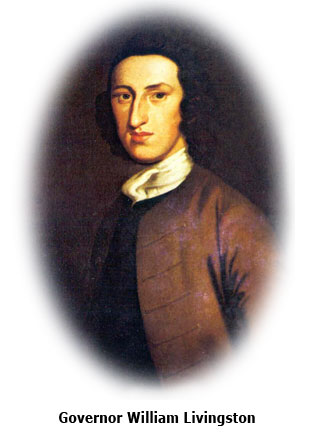
Governor William Livingston
(The man behind the chapter)
William Livingston — scholar, attorney, editor, legislator, farmer, patriot and the first governor of New Jersey — was born in 1723. The prominent Livingston family lived in Albany, New York.
A graduate of Yale University, he ventured to New York City to pursue a career in law. He founded the Independent Reflector, a weekly newspaper which speared his drive into politics.
By 1772, he and his wife, Elizabeth, had moved to Elizabethtown (known today as Elizabeth), New Jersey. Their homestead was occupied and ransacked by British troops during the American Revolution. After the war, the Livingston family rebuilt their home and occupied it once again. Today, it is a museum known as Liberty Hall.
Known for his vocal opinions about patriotic independence for the colonies, William Livingston was elected to the Continental Congress in July, 1774, and served until July, 1776. He fought with the famous New Jersey Militia, and attained the rank of Brigadier General.
In August, 1776, William Livingston was elected the first governor of New Jersey. Governor Livingston led the New Jersey delegation to the 1787 Constitutional Convention in Philadelphia, Pennsylvania. He served as the New Jersey govenor until his death in 1790, at the age of 67.


The content contained herein does not necessarily represent the position of the NSDAR. Hyperlinks to other sites are not the responsibility of the NSDAR, the state organizations, or individual DAR chapters.